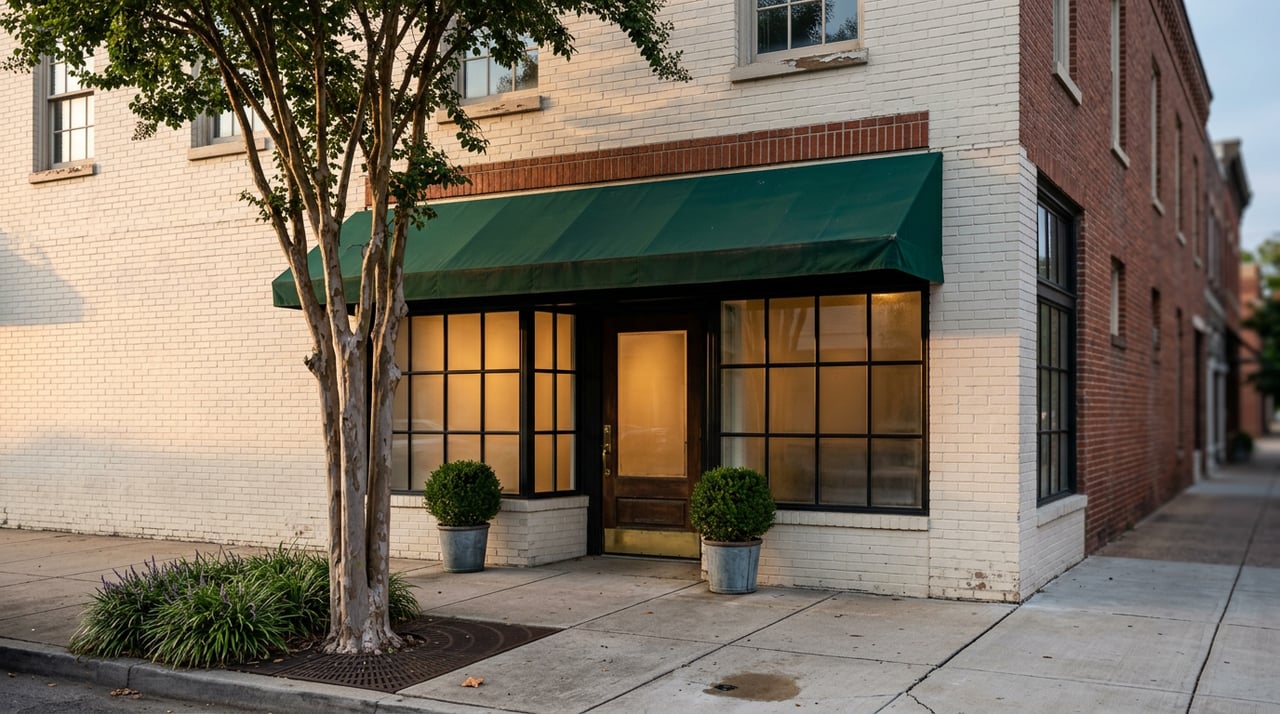
Walk to the far end of the Taylors Mill parking lot past Dock 3 and you will find a door that used to lead somewhere loud. For eight years, that door opened into 13 Stripes Brewery, the taproom that turned a dead corner of a 1920s textile plant into the place Upstate beer drinkers actually wanted to be on a Friday night. As of this summer, the door still opens. The space behind it does not.
13 Stripes closed its Taylors location and relocated to Hampton Station in Greenville's Water Tower District, where it now occupies a 9,000-square-foot space formerly split between Birds Fly South Ale Project and White Duck Taco. The new location, backed by Hampton Station owner Abacus Capital, was slated to open this spring. Back at the Mill, the old 8,000-square-foot taproom has been sitting on the commercial market since, listed on LoopNet as of June 2026 as a turnkey shell for a production brewery, distillery, or other hospitality concept. As of that listing, no new tenant had been announced.
If you live in Taylors and treat the Mill as a regular stop, that gap matters to you in a way it does not to a passerby. But the more interesting fact is not that the space is empty. It is what the emptiness reveals about how this place was built to absorb exactly this kind of loss.
Why 13 Stripes actually left
This was not a business failing. 13 Stripes opened its Taylors Mill taproom in May 2017 and built an eight-year run as one of the Upstate's most recognized craft breweries. The move was about outgrowing the room, not the market. Co-founder Aaron Robinson explained the calculus plainly when the deal was announced:
"We needed some extra space, wanted to have a built-in kitchen and green space. There's a lot of things that we are lacking in our current space that Hampton Station is able to provide over there."
Hampton Station offered something the Mill's old taproom could not: a built-in kitchen, and proximity to The Yard, Hampton Station's renovated green space with a putt-putt course and picnic seating. Taylors Mill is a working industrial complex with concrete floors and drive-in bays, not a purpose-built food-and-drink destination. For a brewery scaling toward more food service and outdoor seating, that distinction stopped being a quirk and started being a ceiling.
Taylors Mill owner Caleb Lewis did not treat the departure as a wound. In the same announcement, he said simply that the search was underway:
"Our focus now is identifying the right tenant and concept for this space, and we are excited for the future. We've had several promising conversations about the space and look forward to sharing more about future plans soon."
That was October 2025. Ten months later, the space is still on the market. Whether that reflects a landlord being selective or a harder search than expected is not public information. What is public is that the rest of the Mill has not paused waiting for an answer.
What's actually gone versus what's still there
The easiest way to see how contained this change is: lay out what left against what didn't.
| Status | Business | What it was or is |
|---|---|---|
| Left | 13 Stripes Brewery | Craft brewery and taproom, 2017 to 2025, now at Hampton Station |
| Still open | The Farehouse | Casual American restaurant next door to the old taproom, chef-driven menu and weekly specials |
| Still open | Pinky's Revenge Arcade and Game Lounge | Arcade and game bar |
| Still open | Blue Ox Hatchet House | Axe-throwing venue |
| Still open | Mad Smash | Rage room |
| Still open | Model Trains Station | Model train exhibit and hobby space |
| Still open | Angie Bryant Art, Christopher Rico Studios, Matthew Zedler Fine Art | Working artist studios |
| Still open | The Vault at Taylors Mill | Historic event venue |
| Adjacent, not technically Mill tenants | Junto Coffee, Next Level Performance Baseball, Crossfit Taylors | Neighbors the Mill points visitors toward |
According to the October 2025 announcement of the move, Taylors Mill sat above 95 percent leased with close to 70 businesses on site. One name leaving a complex that size is a footnote, not a story, unless you happened to love that particular taproom.
The Mill was never built around one name
Here is the part that explains why an anchor leaving didn't rattle the place. Taylors Mill was not designed the way most redevelopments are, with a marquee tenant and everyone else filling in around it. When the property was purchased in the late 2000s, the strategy from the start was to skip the hunt for one big signature tenant and instead rent smaller spaces directly to small business owners and creative entrepreneurs. That approach predates 13 Stripes entirely and it's the reason the Mill's tenant roster reads like a directory instead of a highlight reel: photographers, a textile artist who sells at farmers markets, a recycling company, a catering business, an invitation studio, three separate fine art studios, and a rotating cast of food and entertainment operators.
The building itself has absorbed bigger disruptions than a lease change. It opened in 1924 as the Southern Bleachery and Print Works and ran as a central employer in the local textile economy until it closed in 1965. The complex sat shuttered for decades before developer Kenneth Walker purchased it in 2008 and began the redevelopment that earned it a spot on the National Register of Historic Places in 2012. Caleb Lewis took ownership in 2015, continuing the same small-tenant model. A property that survived that long a closure and a full identity change from industrial plant to creative hub is not going to be destabilized by one brewery relocating to another part of Greenville.
That is the actual shift worth understanding if you spend time at the Mill: it was never really "the place with the brewery." It has always been a portfolio of roughly 70 small bets, and losing one of the more visible bets doesn't touch the other 69.
What this looks like if you're there this month
For now, the practical version is straightforward. The Farehouse is still the anchor food stop, still serving its rotating chef-driven menu and weekly pizza and wine specials at 250 Mill Street. Pinky's Revenge, Mad Smash, and the Model Trains Station are unaffected. If you're bringing kids, none of the family-facing tenants moved. If you're a regular at trivia nights or the jam sessions that used to happen in the taproom, that specific calendar slot is gone until a new tenant fills the room and decides what kind of programming, if any, it wants to run.
The Mill still hosts art shows, makers markets, and food truck nights through the year, largely independent of any single tenant's schedule. Parking still routes through Dock 3, with overflow across Mill Street when the main lot fills, which it regularly does on event weekends.
If you're curious whether the old taproom space gets filled by another brewery or something else entirely, the honest answer is nobody outside the ownership group knows yet. The commercial listing description leaves the door open to a production brewery, a distillery, or a different hospitality concept altogether. Given that the space still has the bones for a brew system and canning line built in, a beverage-focused replacement seems like the more efficient path, but that's a read on the listing, not a confirmed plan.
The takeaway for anyone who lives here
The lesson in watching this play out isn't really about beer. It's about what makes a place like Taylors Mill durable. A single-tenant retail center loses its anchor and the whole property feels hollow for a year. A complex built on volume, on dozens of independent operators each responsible for their own square footage, treats the same event as routine turnover. That's worth knowing if you're the kind of resident who plans a Friday around whichever tenant currently occupies that corner unit. The corner will change hands again. The Mill, as a place, isn't going anywhere.
If you're weighing what a neighborhood like Taylors actually offers day to day, beyond the listing photos and the drive-by impression, that's the kind of on-the-ground read Ashley Swann builds into every conversation about the Upstate. Let's Connect if you want the fuller picture of what living near Taylors Mill, Wade Hampton Boulevard, or any corner of the Upstate actually feels like once you're the one parking in Dock 3 on a Friday night.